
Phân tích nghiệp vụ (BA) · chủ đề 5/13
Thu thập yêu cầu
Requirements elicitation
32 thuật ngữ32 câu ví dụ📐 kí hiệu, đơn vị, công thức
Làm quen dự án phần mềm2 chủ đề
Quy trình làm phần mềm2 chủ đề
Yêu cầu2 chủ đề
Tài liệu và mô hình hoá2 chủ đề
Kiểm thử, dữ liệu, tích hợp2 chủ đề
Sản phẩm và chiến lược2 chủ đề
Giao tiếp hằng ngày1 chủ đề
Luyện thẻ ghi nhớ
💡 Mẹo: lật thẻ để xem nghĩa, bấm loa để nghe giọng Anh-Anh.
/rɪˈkwaɪəmənt/
yêu cầu (requirement)
A condition or capability that a solution must have to meet a need.
gather / document a requirement; requirements document
Each requirement must be clear and testable.
Mỗi yêu cầu phải rõ ràng và kiểm thử được.
/ɪˌlɪsɪˈteɪʃn/
thu thập yêu cầu (elicitation)
Drawing out information and needs from stakeholders and other sources.
elicitation technique; elicit requirements
Requirements elicitation includes interviews and workshops.
Việc thu thập yêu cầu bao gồm phỏng vấn và workshop.
/ˈsteɪkhəʊldə əˈnæləsɪs/
phân tích bên liên quan (stakeholder analysis)
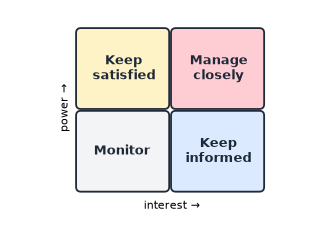
Identifying stakeholders and assessing their influence, interest and needs.
power / interest grid
We did a stakeholder analysis before the kickoff.
Chúng tôi đã phân tích các bên liên quan trước buổi kickoff.
/ˈsteɪkhəʊldə mæp/
bản đồ bên liên quan (stakeholder map)
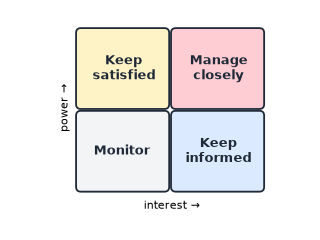
A diagram placing stakeholders by influence and interest.
stakeholder map / matrix
The stakeholder map shows who we need to keep closely engaged.
Bản đồ bên liên quan cho thấy ai cần được giữ liên hệ chặt chẽ.
/ˈɪntəvjuː/
phỏng vấn (interview)
A one-to-one or small-group conversation used to gather requirements.
stakeholder interview; interview questions
I will interview the finance manager about the approval process.
Tôi sẽ phỏng vấn quản lý tài chính về quy trình phê duyệt.
/ˌkwestʃəˈneə/
bảng câu hỏi (questionnaire)
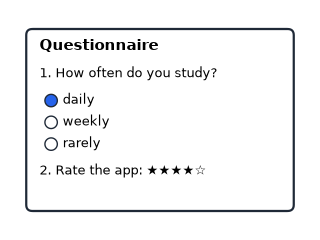
A written set of questions sent to many people to collect their needs.
fill in a questionnaire
We sent a questionnaire to 200 end users.
Chúng tôi đã gửi bảng câu hỏi cho 200 người dùng cuối.
/ˈsɜːveɪ/
khảo sát (survey)
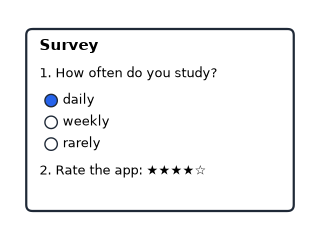
Collecting answers from a group of people, usually online, to measure opinions or needs.
user survey; run / send a survey
The survey shows most users want a mobile version.
Khảo sát cho thấy hầu hết người dùng muốn có phiên bản di động.
/ˈwɜːkʃɒp/
buổi workshop (workshop)
A facilitated group session to discuss, define or agree requirements.
requirements workshop; facilitate
We will run a requirements workshop with the business team.
Chúng tôi sẽ tổ chức một workshop yêu cầu với nhóm nghiệp vụ.
/ˈfəʊkəs ɡruːp/
nhóm thảo luận tập trung (focus group)
A small group of users guided in a discussion to share opinions on a product.
run a focus group
The focus group disliked the new menu layout.
Nhóm thảo luận tập trung không thích bố cục menu mới.
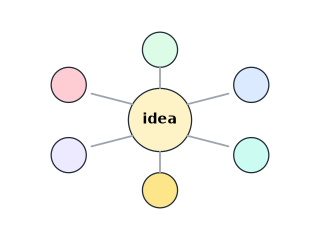
/ˈbreɪnstɔːmɪŋ/
động não, cùng nghĩ ý tưởng (brainstorming)
A group technique for generating many ideas quickly without judging them.
brainstorming session; brainstorm
We used brainstorming to list possible solutions.
Chúng tôi dùng động não để liệt kê các giải pháp có thể.
/ˌɒbzəˈveɪʃn/
quan sát (observation)
Watching users do their work to understand how a process really runs.
user observation; observe users
Observation showed that staff copy data by hand.
Việc quan sát cho thấy nhân viên sao chép dữ liệu thủ công.
/ˈdʒɒb ˌʃædəʊɪŋ/
quan sát người dùng làm việc thực tế (job shadowing)
Following a user through their normal workday to learn the real process.
shadow a user
Job shadowing helped me see the real pain points.
Việc theo sát công việc giúp tôi thấy được các điểm nghẽn thực tế.
/ˈdɒkjʊmənt əˈnæləsɪs/
phân tích tài liệu (document analysis)
Reviewing existing documents to find requirements and business rules.
analyse existing documents
Document analysis of the old manuals revealed several rules.
Việc phân tích tài liệu của các sổ tay cũ đã làm lộ ra nhiều quy tắc.
/ˈɪntəfeɪs əˈnæləsɪs/
phân tích giao diện (interface analysis)
Examining how a system connects with users or other systems to find requirements.
system interfaces; API analysis
Interface analysis identified three external systems.
Phân tích giao diện đã xác định được ba hệ thống bên ngoài.
/rɪˌvɜːs endʒɪˈnɪərɪŋ/
phân tích ngược (reverse engineering)
Studying an existing system to work out how it works and what it requires.
legacy system with no docs
We used reverse engineering to understand the undocumented system.
Chúng tôi dùng kỹ thuật đảo ngược để hiểu hệ thống không có tài liệu.
/ˈkʌrənt steɪt/
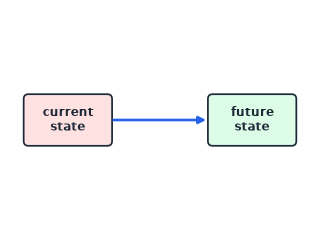
hiện trạng (current state)
How the business, process or system works today.
current-state analysis; as-is
First, let's document the current state of the process.
Trước tiên, hãy ghi lại hiện trạng của quy trình.
/ˈfjuːtʃə steɪt/
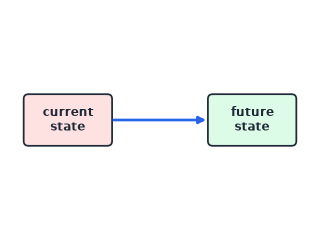
trạng thái mong muốn (future state)
How the business or system should work after the change.
future-state process; to-be
The future state removes manual data entry.
Trạng thái mong muốn loại bỏ việc nhập dữ liệu thủ công.
/ˌæz ˈɪz ˌprəʊses/
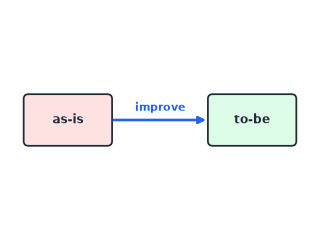
quy trình hiện tại (as-is process)
A description of how a business process works today, before improvement.
as-is vs to-be; map the as-is
I mapped the as-is process in a flowchart.
Tôi đã vẽ quy trình hiện tại bằng sơ đồ luồng.
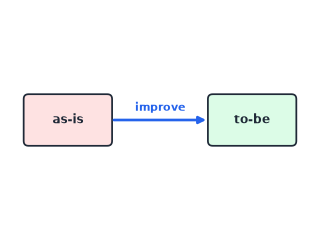
/ˌtuː ˈbiː ˌprəʊses/
quy trình tương lai (to-be process)
A description of how a process should work after the solution is in place.
design the to-be process
The to-be process shortens approval from five days to one.
Quy trình tương lai rút ngắn việc phê duyệt từ năm ngày xuống một ngày.
/ˈpeɪn pɔɪnt/
vấn đề nhức nhối, điểm nghẽn (pain point)
A specific problem or frustration that users or the business experience.
identify / address pain points
The biggest pain point is entering the same data twice.
Điểm đau lớn nhất là phải nhập cùng dữ liệu hai lần.
/ˈbɪznɪs niːd/
nhu cầu nghiệp vụ (business need)
A problem or opportunity in the business that a project should address.
business case starts from the need
The business need is to reduce order errors.
Nhu cầu nghiệp vụ là giảm lỗi đơn hàng.
/ˈbɪznɪs ˈprɒbləm/
vấn đề nghiệp vụ (business problem)
A difficulty in the business that stops it reaching its goals.
problem statement
Let's define the business problem before jumping into solutions.
Hãy xác định vấn đề nghiệp vụ trước khi bàn giải pháp.
/ˌklærɪfɪˈkeɪʃn/
làm rõ (clarification)
An explanation that removes doubt about a requirement or statement.
ask for / need clarification; clarify
Could you give me a clarification on this rule?
Bạn có thể làm rõ giúp tôi quy tắc này không?
/ˌəʊpən ˈkwestʃən/
câu hỏi mở (open question)
A question that needs a full answer, not just yes or no.
ngược với closed question
Start with an open question: how do you process orders today?
Hãy bắt đầu bằng câu hỏi mở: hiện nay bạn xử lý đơn hàng như thế nào?
/ˌkləʊzd ˈkwestʃən/
câu hỏi đóng (closed question)
A question answered with yes, no or a short fact.
yes / no question; để xác nhận
Use a closed question to confirm: is approval required?
Dùng câu hỏi đóng để xác nhận: có cần phê duyệt không?
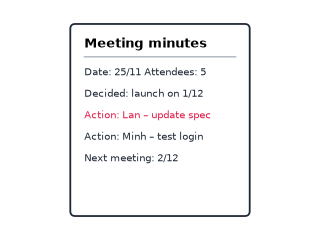
/ˈmiːtɪŋ ˈmɪnɪts/
biên bản họp (meeting minutes)
A written record of what was discussed and decided in a meeting.
take / send the minutes; MoM
I will send the meeting minutes by the end of the day.
Tôi sẽ gửi biên bản họp trước cuối ngày.
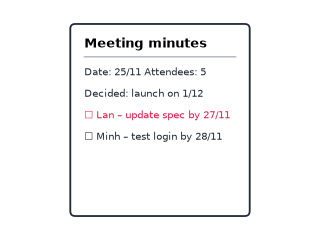
/ˈækʃn ˌaɪtəm/
đầu việc cần làm (action item)
A specific task assigned to a person after a meeting, with a due date.
assign / follow up an action item
There are three action items from today's meeting.
Có ba đầu việc cần làm từ cuộc họp hôm nay.
/əˈsʌmpʃn/
giả định (assumption)
Something treated as true for planning without having been confirmed.
assumptions and constraints
We assume the client will provide test data; this is an assumption.
Chúng tôi giả định khách hàng sẽ cung cấp dữ liệu test; đây là một giả định.
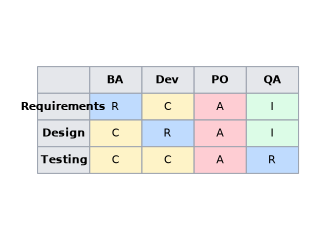
/ˈreɪsi ˌmeɪtrɪks/
ma trận RACI (RACI matrix)
A table showing who is Responsible, Accountable, Consulted and Informed for each activity.
RACI = Responsible, Accountable, Consulted, Informed
Let's agree on roles using a RACI matrix.
Hãy thống nhất vai trò bằng ma trận RACI.
/pəˈsəʊnə/
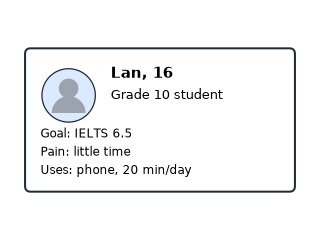
chân dung người dùng (persona)
A fictional profile of a typical user, used to understand their goals and needs.
create a persona; user persona
We created three personas for the app.
Chúng tôi đã tạo ba persona cho ứng dụng.
/ˈjuːzə ˈdʒɜːni/
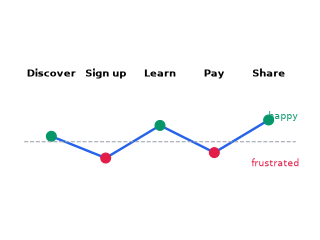
hành trình người dùng (user journey)
The steps a user takes to achieve a goal when using a product.
map the user journey
The user journey for ordering has seven steps.
Hành trình người dùng khi đặt hàng gồm bảy bước.
/ˈkʌstəmə ˈdʒɜːni mæp/
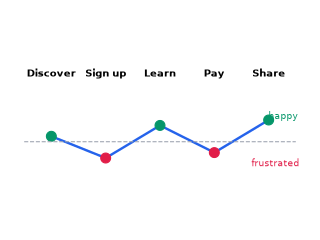
bản đồ hành trình khách hàng (customer journey map)
A visual of the stages, actions and feelings of a customer when dealing with a company.
touchpoints; emotions
The customer journey map shows where customers drop off.
Bản đồ hành trình khách hàng cho thấy chỗ khách hàng bỏ đi.