
Phân tích nghiệp vụ (BA) · chủ đề 11/13
Sản phẩm và chỉ số
Product and metrics
29 thuật ngữ29 câu ví dụ📐 kí hiệu, đơn vị, công thức
Làm quen dự án phần mềm2 chủ đề
Quy trình làm phần mềm2 chủ đề
Yêu cầu2 chủ đề
Tài liệu và mô hình hoá2 chủ đề
Kiểm thử, dữ liệu, tích hợp2 chủ đề
Sản phẩm và chiến lược2 chủ đề
Giao tiếp hằng ngày1 chủ đề
Luyện thẻ ghi nhớ
💡 Mẹo: lật thẻ để xem nghĩa, bấm loa để nghe giọng Anh-Anh.

/ˈprɒdəkt/
sản phẩm (product)
The software or service that a team builds and delivers to its users.
Product owner, product backlog.
Our product helps small shops manage their stock.
Sản phẩm của chúng tôi giúp các cửa hàng nhỏ quản lý hàng tồn kho.
/ˌem viː ˈpiː/
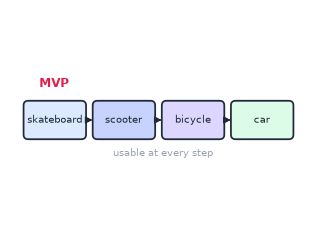
sản phẩm khả dụng tối thiểu (MVP)
The simplest version of a product that can be released to test the idea with real users.
Viết tắt MVP.
We will launch an MVP with only three core features.
Chúng tôi sẽ ra mắt MVP chỉ với ba tính năng cốt lõi.
/ˈprɒdʌkt ˈrəʊdmæp/
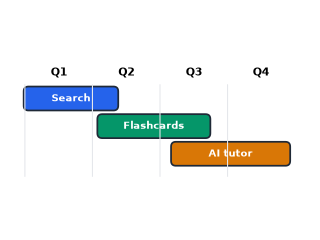
lộ trình sản phẩm (product roadmap)
A high-level plan showing what will be built and roughly when.
Thường cập nhật theo quý.
The product roadmap shows the mobile app in the third quarter.
Lộ trình sản phẩm cho thấy ứng dụng di động ở quý ba.
/ˈprɒdʌkt ˈvɪʒn/
tầm nhìn sản phẩm (product vision)
A short statement of what the product aims to achieve in the long term.
Định hướng cho roadmap.
The product vision is to make online payment simple for everyone.
Tầm nhìn sản phẩm là làm cho thanh toán trực tuyến trở nên đơn giản với mọi người.
/ˈvæljuː ˌprɒpəˈzɪʃn/
đề xuất giá trị (value proposition)
A statement of the benefit a product gives customers and why they should choose it.
Trả lời "vì sao chọn chúng tôi".
Our value proposition is faster onboarding at a lower cost.
Đề xuất giá trị của chúng tôi là tiếp nhận nhanh hơn với chi phí thấp hơn.
/ˈmɑːkɪt rɪˈsɜːtʃ/
nghiên cứu thị trường (market research)
Collecting information about customers, competitors and demand before building a product.
Gồm khảo sát, phỏng vấn.
Market research shows that most users prefer paying by e-wallet.
Nghiên cứu thị trường cho thấy hầu hết người dùng thích thanh toán bằng ví điện tử.
/kəmˈpetɪtər əˈnæləsɪs/
phân tích đối thủ cạnh tranh (competitor analysis)
Studying rival products to learn their strengths, weaknesses and gaps.
Thường dùng bảng so sánh.
The competitor analysis highlighted a gap in mobile support.
Phân tích đối thủ chỉ ra khoảng trống ở hỗ trợ di động.
/ˈjuːzə rɪˈsɜːtʃ/
nghiên cứu người dùng (user research)
Learning about users' needs and behaviour through interviews, surveys and observation.
Nhóm UX/BA cùng làm.
User research told us that most customers abandon the form at step three.
Nghiên cứu người dùng cho chúng tôi biết hầu hết khách hàng bỏ biểu mẫu ở bước ba.
/ˌeɪ ˈbiː ˈtestɪŋ/
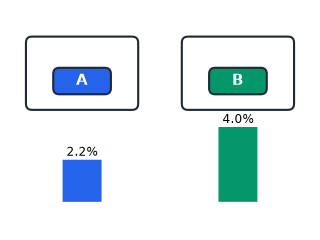
thử nghiệm A/B (A/B testing)
Comparing two versions of a page or feature to see which one performs better.
Đọc "A B testing".
We ran A/B testing on the button colour for two weeks.
Chúng tôi đã chạy thử nghiệm A/B cho màu nút trong hai tuần.
/kənˈvɜːʃn reɪt/
tỷ lệ chuyển đổi (conversion rate)
The percentage of users who complete a wanted action, such as signing up or buying.
Chỉ số phễu bán hàng.
The conversion rate rose from 2% to 3.5% after the redesign.
Tỷ lệ chuyển đổi tăng từ 2% lên 3,5% sau khi thiết kế lại.
/rɪˈtenʃən/
tỷ lệ giữ chân (retention)
How many users keep using a product over time.
Ví dụ: day-30 retention.
Retention drops sharply after the first week.
Tỷ lệ giữ chân giảm mạnh sau tuần đầu tiên.
/tʃɜːn/
tỷ lệ rời bỏ (churn)
The rate at which customers stop using or paying for a product.
Trái với retention.
Monthly churn is currently 4%.
Tỷ lệ rời bỏ hằng tháng hiện là 4%.
/ˌkeɪ piː ˈaɪ/
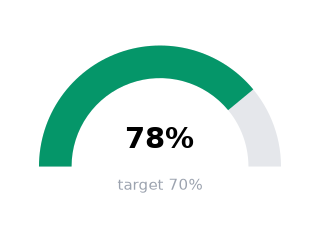
chỉ số đo hiệu quả (KPI)
A measurable number used to check progress toward a business goal.
Key Performance Indicator.
Our main KPI this quarter is the number of active users.
KPI chính của chúng tôi quý này là số người dùng hoạt động.
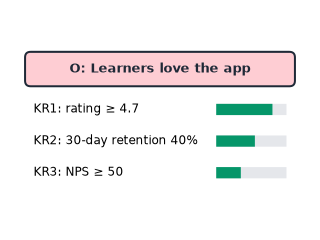
/ˌəʊ keɪ ˈɑː/
mục tiêu và kết quả then chốt (OKR)
A goal-setting method with an objective and measurable key results.
Objectives and Key Results.
Our OKR for this quarter is to reduce onboarding time by 30%.
OKR của chúng tôi quý này là giảm thời gian tiếp nhận 30%.
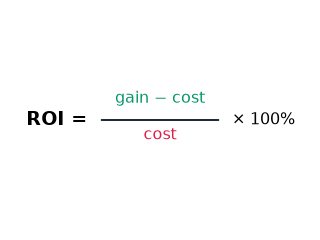
/ˌɑːr əʊ ˈaɪ/
tỷ suất hoàn vốn (ROI)
A measure comparing the profit gained from an investment with its cost.
Return on Investment.
The business case shows an ROI of 20% in the first year.
Business case cho thấy ROI là 20% trong năm đầu tiên.
/ˈmetrɪk/
chỉ số (metric)
A number used to measure how a product, process or team is performing.
Gần nghĩa KPI nhưng rộng hơn.
Which metric will tell us whether the feature is successful?
Chỉ số nào sẽ cho chúng ta biết tính năng này có thành công không?
/ˌnɔːθ stɑː ˈmetrɪk/
chỉ số kim chỉ nam (north star metric)
The single key number that best shows the value a product gives to its users.
Giữ nguyên tiếng Anh.
Our north star metric is the number of orders completed each week.
Chỉ số North Star của chúng tôi là số đơn hoàn thành mỗi tuần.
/ˈfiːtʃə rɪˌkwest/
yêu cầu tính năng mới (feature request)
A suggestion from a user or client asking for a new capability.
Cần đánh giá và ưu tiên.
We received a feature request for dark mode.
Chúng tôi nhận được một yêu cầu tính năng cho chế độ tối.
/ˈfiːdbæk/
phản hồi (feedback)
Comments from users or stakeholders about the product or work.
Không đếm được: some feedback.
Thank you for your feedback on the draft.
Cảm ơn bạn đã góp ý cho bản nháp.
/ˌkʌstəmə sætɪsˈfækʃn/
mức độ hài lòng của khách hàng (customer satisfaction)
How happy customers are with a product or service, often measured by a survey.
Viết tắt CSAT.
Customer satisfaction improved after we simplified the checkout.
Mức độ hài lòng của khách hàng được cải thiện sau khi chúng tôi đơn giản hoá bước thanh toán.
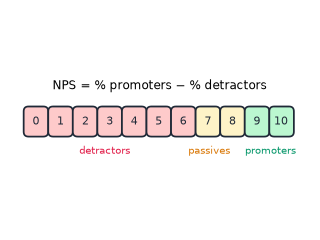
/ˌnet prəˈməʊtə skɔː/
chỉ số NPS (net promoter score)
A score showing how likely customers are to recommend a product to others.
Viết tắt NPS.
Our net promoter score went up by ten points.
Điểm net promoter score của chúng tôi tăng mười điểm.
/əˈdɒpʃn/
mức độ chấp nhận sử dụng (adoption)
How many users start using a new product or feature.
Feature adoption rate.
Adoption of the new dashboard is lower than expected.
Mức độ sử dụng dashboard mới thấp hơn dự kiến.
/ˌɡəʊ tə ˈmɑːkɪt/
chiến lược đưa ra thị trường (go-to-market)
A plan for how a product will be launched and sold to customers.
Viết tắt GTM.
The go-to-market plan includes a pilot with two key clients.
Kế hoạch go-to-market gồm một đợt thí điểm với hai khách hàng chính.
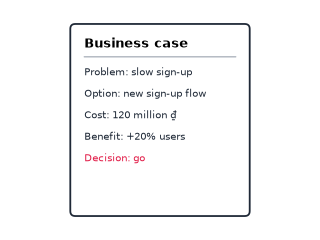
/ˈbɪznəs keɪs/
đề án kinh doanh (business case)
A document explaining why a project is worth doing, with costs, benefits and risks.
Dựa vào đó để duyệt ngân sách.
The steering committee approved the business case last week.
Ban chỉ đạo đã phê duyệt business case tuần trước.
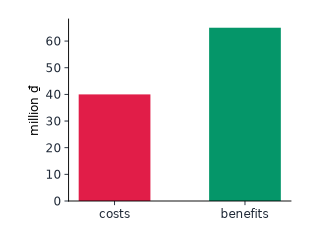
/ˌkɒst ˈbenɪfɪt əˈnæləsɪs/
phân tích chi phí - lợi ích (cost-benefit analysis)
Comparing the costs of an option with its expected benefits to decide whether to go ahead.
Thường nằm trong business case.
The cost-benefit analysis favours the cloud option.
Phân tích chi phí - lợi ích nghiêng về phương án đám mây.
/ˈbenɪfɪt/
lợi ích (benefit)
The positive result a solution gives to the business or its users.
Phân biệt benefit và feature.
The main benefit of automation is faster processing.
Lợi ích chính của tự động hoá là xử lý nhanh hơn.
/ˈvæljuː/
giá trị (value)
How much a solution matters to the business or users, in money or usefulness.
Business value.
We should deliver the highest-value features first.
Chúng ta nên giao các tính năng giá trị nhất trước.
/ˈaʊtkʌm/
kết quả cuối cùng (outcome)
The real change or benefit the business gets after a solution is used.
Khác output (sản phẩm bàn giao).
The outcome we want is fewer support calls.
Kết quả mà chúng tôi muốn là ít cuộc gọi hỗ trợ hơn.
/ˈaʊtpʊt/
đầu ra, sản phẩm bàn giao (output)
What a project or process produces, such as a report or a feature.
Khác outcome.
The output of this phase is the approved specification.
Đầu ra của giai đoạn này là bản đặc tả đã được phê duyệt.