
Du lịch – nhà hàng – khách sạn · chủ đề 6/14
An toàn thực phẩm và HACCP
Food safety and HACCP
29 thuật ngữ29 câu ví dụ📐 kí hiệu, đơn vị, công thức
Làm quen khách sạn1 chủ đề
Lễ tân, buồng phòng, nhà hàng3 chủ đề
Bếp, bar và lữ hành4 chủ đề
Vé bay và sự kiện MICE2 chủ đề
Doanh thu và chất lượng2 chủ đề
Du lịch bền vững1 chủ đề
Giao tiếp nơi làm việc1 chủ đề
Luyện thẻ ghi nhớ
💡 Mẹo: lật thẻ để xem nghĩa, bấm loa để nghe giọng Anh-Anh.
/ˈhæzəd əˌnæləsɪs/
phân tích mối nguy
The step of identifying what could make food unsafe and judging how likely and how serious each risk is.
Nguyên tắc 1 của HACCP
We carried out a hazard analysis for the new menu.
Chúng tôi đã phân tích mối nguy cho thực đơn mới.
/ˌbaɪəˈlɒdʒɪkl ˈhæzəd/
mối nguy sinh học
A danger from living organisms such as bacteria, viruses and parasites in food.
Vi khuẩn, virus, ký sinh trùng
Raw chicken is a common biological hazard.
Thịt gà sống là mối nguy sinh học thường gặp.
/ˈkemɪkl ˈhæzəd/
mối nguy hoá học
A danger from harmful substances such as cleaning products, pesticides or toxins in food.
Gồm cả allergen theo một số hệ thống
Store cleaning chemicals away from food to avoid a chemical hazard.
Cất hoá chất tẩy rửa xa thực phẩm để tránh mối nguy hoá học.
/ˌfɪzɪkl ˈhæzəd/
mối nguy vật lý
A danger from foreign objects in food, such as glass, metal, bone or plastic.
Kim loại, thuỷ tinh, xương, nhựa
A piece of glass is a serious physical hazard.
Mảnh thuỷ tinh là mối nguy vật lý nghiêm trọng.
/ˈpæθədʒən/
vi sinh vật gây bệnh
A micro-organism that can cause disease, such as a bacterium or virus.
Salmonella, Listeria, E. coli
Cooking to the right temperature destroys most pathogens.
Nấu đúng nhiệt độ tiêu diệt hầu hết vi sinh vật gây bệnh.
/ˌsælməˈnelə/
vi khuẩn salmonella
A group of bacteria often found in raw eggs, poultry and meat that cause food poisoning.
Triệu chứng sau 6–72 giờ
Salmonella can grow in undercooked eggs.
Salmonella có thể phát triển trong trứng chưa chín.
/ˈnɔːrəʊˌvaɪrəs/
norovirus (virus gây nôn mửa, tiêu chảy)
A highly contagious virus that causes vomiting and diarrhoea and is often spread by infected food handlers.
Nghỉ ≥ 48 giờ sau hết triệu chứng
Staff with norovirus must stay at home for 48 hours.
Nhân viên nhiễm norovirus phải nghỉ ở nhà 48 giờ.
/ˈfuːd ˌpɔɪzənɪŋ/
ngộ độc thực phẩm
An illness caused by eating food that contains harmful bacteria, toxins or chemicals.
Luật An toàn thực phẩm 2010
Twelve guests reported food poisoning after the banquet.
Mười hai khách báo bị ngộ độc thực phẩm sau tiệc.
/ˌkrɒs kənˌtæmɪˈneɪʃn/
nhiễm chéo
The transfer of harmful bacteria from one food, surface or person to another.
Thịt sống ≠ thực phẩm ăn liền
Separate boards prevent cross-contamination.
Thớt riêng giúp ngăn nhiễm chéo.
/ˈhæsʌp/
HACCP (phân tích mối nguy và điểm kiểm soát tới hạn)
A system that identifies and controls the hazards in food production at critical points.
Gồm 7 nguyên tắc
Every hotel kitchen should follow HACCP.
Mọi bếp khách sạn nên tuân thủ HACCP.
/ˌkrɪtɪkl kənˈtrəʊl pɔɪnt/
điểm kiểm soát tới hạn (CCP)
A step in food preparation at which control is essential to prevent or remove a hazard.
Viết tắt CCP
Cooking chicken is a critical control point.
Nấu gà là một điểm kiểm soát tới hạn.
/ˌkrɪtɪkl ˈlɪmɪt/
giới hạn tới hạn
The maximum or minimum value, such as a temperature, that must be met at a critical control point.
Ví dụ: ≥ 75 °C ở lõi
The critical limit for cooked chicken is 75 degrees.
Giới hạn tới hạn của gà chín là 75 độ.
/kəˌrektɪv ˈækʃn/
hành động khắc phục
The action taken when monitoring shows that a critical limit has not been met.
Ghi vào hồ sơ
The corrective action was to cook the batch again.
Hành động khắc phục là nấu lại cả mẻ.
/ˌtreɪsəˈbɪləti/
truy xuất nguồn gốc
The ability to follow a food product back to its supplier and forward to the customer.
Luật An toàn thực phẩm 2010
Traceability helps us recall a bad batch quickly.
Truy xuất nguồn gốc giúp chúng tôi thu hồi nhanh lô hàng lỗi.
/ˌaɪ es əʊ ˌtwenti tuː ˈθaʊzənd/
ISO 22000 (tiêu chuẩn hệ thống quản lý an toàn thực phẩm)
An international standard for food safety management that includes HACCP principles.
TCVN ISO 22000
The hotel kitchen is certified to ISO 22000.
Bếp khách sạn được chứng nhận ISO 22000.
/ˈtemprətʃər ˈdeɪndʒə zəʊn/
vùng nhiệt độ nguy hiểm
The range, about 5 to 63 degrees Celsius, in which bacteria multiply fastest.
Khoảng 5–60 °C (tuỳ quy chuẩn; Anh: 8–63 °C)
Do not leave food in the temperature danger zone for over two hours.
Đừng để thực phẩm trong vùng nhiệt độ nguy hiểm quá hai giờ.
/ˈkɔː ˈtemprətʃə/
nhiệt độ lõi
The temperature at the centre of the thickest part of a food item.
Gà ≥ 75 °C
Check the core temperature with a probe.
Kiểm tra nhiệt độ lõi bằng que đo.
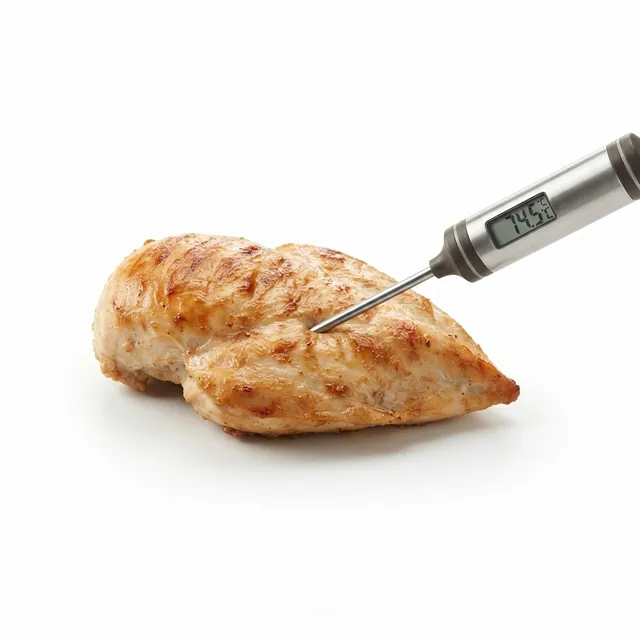
/ˈprəʊb θəˈmɒmɪtə/
nhiệt kế que
A thermometer with a metal tip that is inserted into food to measure its temperature.
Hiệu chuẩn định kỳ
Clean the probe thermometer between uses.
Lau sạch nhiệt kế que giữa các lần đo.
/ˈkəʊld tʃeɪn/
chuỗi lạnh
The continuous refrigerated storage and transport of food from supplier to table.
Lạnh ≤ 5 °C; đông ≤ −18 °C
A broken cold chain spoils fresh seafood.
Chuỗi lạnh bị đứt làm hỏng hải sản tươi.
/ˈθɔːɪŋ/
rã đông
The slow warming of frozen food until it is soft enough to cook.
Không rã đông ở nhiệt độ phòng
Thaw the fish in the fridge, not on the counter.
Rã đông cá trong tủ lạnh, không để trên bàn.
/ˈfaɪfəʊ/
FIFO (nhập trước, xuất trước)
A stock rotation rule in which the oldest items are used first.
First In, First Out; có cả FEFO theo hạn dùng
Follow FIFO when you restock the fridge.
Hãy theo nguyên tắc nhập trước xuất trước khi bổ sung tủ lạnh.
/ˈjuːz baɪ deɪt/
hạn sử dụng
The date after which perishable food must not be eaten for safety reasons.
≠ best-before date
Throw away any food past its use-by date.
Bỏ mọi thực phẩm quá hạn sử dụng.
/ˌbest bɪˈfɔː deɪt/
hạn dùng tốt nhất
The date until which food keeps its best quality, though it is usually still safe afterwards.
Chất lượng, không phải an toàn
The flour is past its best-before date.
Bột đã quá hạn dùng tốt nhất.
/ˈʃelf laɪf/
thời hạn bảo quản
The length of time a product can be kept before it spoils or loses quality.
Ghi nhãn ngày sản xuất, ngày hết hạn
Fresh fish has a short shelf life.
Cá tươi có thời hạn bảo quản ngắn.
/ˌpɜːsənl ˈhaɪdʒiːn/
vệ sinh cá nhân
The habits that keep food handlers clean, such as washing hands and wearing clean uniforms.
Rửa tay ≥ 20 giây
Good personal hygiene protects guests from illness.
Vệ sinh cá nhân tốt bảo vệ khách khỏi bệnh.
/ˈfuːd ˌhændlə/
người trực tiếp chế biến thực phẩm
Anyone who prepares, cooks, serves or touches food as part of the job.
Cần giấy xác nhận tập huấn ATTP
Every food handler needs hygiene training.
Mọi người trực tiếp chế biến phải được tập huấn vệ sinh.
/ˈsænɪtaɪzə/
chất khử khuẩn bề mặt
A product that reduces bacteria on a clean surface to a safe level.
Làm sạch rồi mới khử khuẩn
Spray sanitiser on the work surface after cleaning.
Xịt chất khử khuẩn lên bàn làm việc sau khi lau.
/ˈkliːnɪŋ ˌʃedjuːl/
lịch vệ sinh
A written plan that says what must be cleaned, how, how often and by whom.
Hồ sơ HACCP
The cleaning schedule is signed after each shift.
Lịch vệ sinh được ký sau mỗi ca.
/ˈpest kənˌtrəʊl/
kiểm soát côn trùng và động vật gây hại
Measures that prevent and remove insects and rodents from the premises.
Gián, chuột, ruồi
A contractor visits monthly for pest control.
Một nhà thầu đến hằng tháng để kiểm soát côn trùng.